Entradas

Cerros Colorado and Santiago, a report by Bill Adsett

Imagen
From June 23 to June 25 Charlotte Elton, Cora Herrera, Dan Hinckley, Celestino Mariano and Bill Adsett visited the mountainous area of Cerros Santiago and Cerro Colorado in the Comarca Ngäbe-Buglé on and near the Continental Divide. On June 23 we explored the new road that turns off eastward from the Cerro Colorado Road at 30.9 km from the Panamericana highway and goes all the way to Llano Tugrí, capital of the Comarca Ngäbe-Buglé. The road is between 1050 and 1300 m above sea level, and passes through degraded land and forest patches (some connected to higher forest), crossing several streams. It was not very birdy but did yield a few species of interest such as White-throated Thrush, White-winged Tanager , Elegant Euphonia, Lesser Nighthawk, Long-billed Starthroat and Torrent Tyrannulet. The road gives a spectacular view of the imposing nearby hills and Cerro Santiago itself (2100 m), most of which are still forested. It is worth further exploration, especially to look for Glow-thro...

Las Lajas Beach, a report by Bill Adsett

Imagen
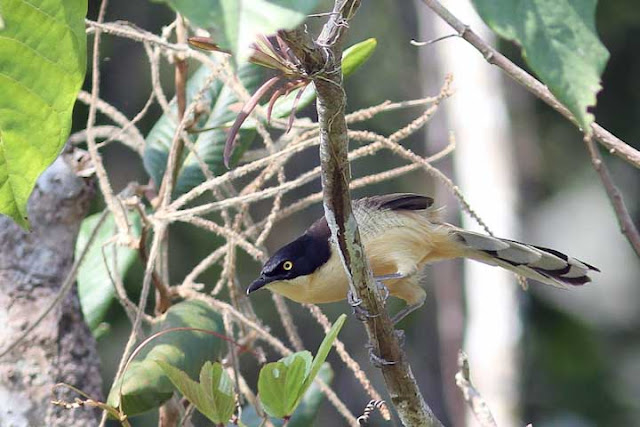
On the evening of June 23, and the morning of June 25 Cora Herrera, Charlotte Elton, Dan Hinckley and Bill Adsett visited the lagoon, swamp and grasslands at Las Lajas beach. On June 23 a Rufous Nightjar was picked up by spotlight near the lagoon. On June 25, bird of the day was Muscovy Duck; at least 4 were seen flying and landing, looking magnificent in the morning light. Other birds of note were unusually tame Pale-breasted Spinetail, Lesser Yellow-headed Vulture, Black-hooded Antshrike , a juvenile Little Blue Heron and the local White-collared Seedeater . We found the colony of Lesser Nighthawks on the far (eastern) end of the beach that was first reported by Craig Bennett a few weeks ago. Thanks Craig. Photographs are by Daniel Hinckley

Western Azuero, a report by Bill Adsett

Imagen
Celeste Paiva, Donnie Pierpoint, Charlotte Elton, Cora Herrera, Dan Hinckley and Bill Adsett visited the western coast of the Azuero Peninsula from June 20 to June 22. We stayed at Las Heliconias B&B(tanagertourism@gmail.com - highly recommended) just beyond Mariato and its co-owner Kees, a good birder, acted as our guide throughout. Las Heliconias has several hectares of regenerating and replanted forest where Pale-eyed Pygmy-Tyrant and Yellow Tyrannulet are common. Hummingbird feeders are attended by Scaly-breasted, Sapphire-throated and Garden Emeralds among others. On June 21 we went to Juan's farm in Flores (on the edge of the Cerro Hoya National Park) to see the main target of the trip, the endemic Azuero Parakeet . A flock of 15-20 birds showed up as scheduled at 9.00 am and several stayed around for hours feeding on a "higuerón" (fig) tree where they could be approached closely and photographed. They should be in the area for two more weeks, after which they...

Melodious Blackbird: a new species for Panama, a report by Euclides Campos

Imagen
During my last trip Bocas del Toro, I decided to do birding close to the border of Costa Rica to check if any new bird species had established itself in Panama. I, Euclides Campos, was a companied by Laura Reyes and David Santos. We drove from Changuinola to Guabito area where we took the road down to Las Tablas town. Continuing through the town, we reached a place called Sinostres, Finca Centinella where we discovered a Melodious Blackbird which flew across the road and perched on the top of a palm tree for a few seconds. We had just enough time to make the identification. Then I used playback to lure it back and suddenly two birds popped out.

Carretera El Llano-Cartí, un reporte por Rosabel Miró

Imagen
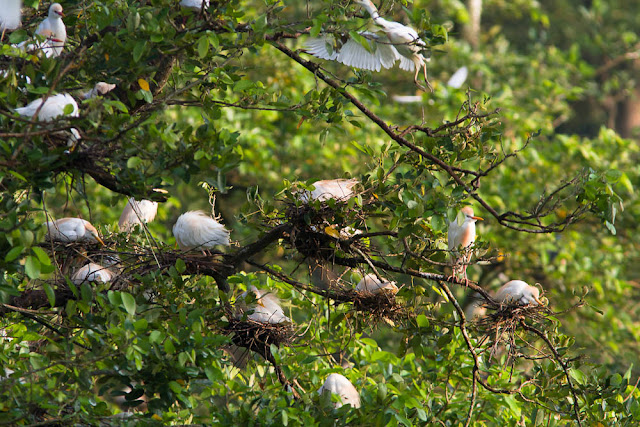
Hoy fuimos a la carretera El Llano-Cartí con Tony y Linda Ward, Michael Froude y Daniel Hinckley. Antes de llegar a Chepo paramos en el sitio de anidamiento de Cattle Egrets. Hay decenas anidando (no las contamos, ver fotos). Entre otras especies anidando conté rápidamente 12 White Ibis (habían más), 7 Little Blue Herons (vimos una en nido con un huevo turquesa) y una 1 Great Egret. De particular interés fue observar no menos de 7 Anhingas (6 machos, 1 hembra) entre las aves que anidaban pero ninguna de las Anhingas estaba posada en un nido. Después fuimos a Cartí. Como a las 7:30 am paramos en el sitio donde encontramos el Central American Pygmy-Owl 2 semanas atrás y Karl lo llamó silbando. Al instante el búho contestó pero nunca lo encontramos. De camino a Cartí nos encontramos con un Plumbeous Kite anidando. En el Río Cartí Grande observamos un Bare-throated Tiger-Heron . Según el libro de George, este debería ser el 2do reporte para el Atlántico.  Otras aves observadas incl...

Eastern Panama Deep Birding Immersion, a report by Venicio Wilson

Imagen
This past weekend I had a complete deep immersion into eastern Panama, that part of the country that remained pure and untouched on it's vast majority until the mid-60's. On Friday 24 and Saturday 25 I was invited by Raúl Arias de Para, along with Carlos Bethancourt and Ismael Hernando Quiróz (the famous Nando from Cerro Azul) to birdwatch the area between Metetí and Yaviza. [ See Carlos' report here ].  On Saturday afternoon, after saying goodbye to my original team, I joined the group of birders from Panama Audubon Society that the next day would observe birds in the forests around Rio Bayano. Claudia and Bill Ahrens, Cindy and Leslie Lieurance, Rosabel and Karl Kaufmann ventured to visit places that we have recently discovered in the area of ​​Tortí.   Early Sunday morning we visited the Playa Chuzo forest where, thanks to an excellent recording played by Bill Ahrens (recorded by Ken Allaire) we saw a couple of Double-banded Graytails  up close, a life...

24 hours of birding in Darién, a report by Carlos Bethancourt

Imagen
About a week ago, May 27, my friend Raúl Arias invited me to check out some spots he has been birding the past 6 months; but not just any spot, it was in Darién! Also invited were one of the top guides in Panama, Beny Wilson, and Hernando ‘Nando.’ Raúl had invited me on their previous trip, but I was swamped with other birding work at the Canopy Tower and Canopy Lodge and just could not pull myself away. Now I was free!  We agreed to bird the Darién area near Yaviza for at least 2 days, but at the last minute our plans changed. Instead of a two-day trip, we would have to cram it all in a 24-hour birding marathon! I was so mentally pumped that I was already daydreaming about finding a Black Oropendola, a lifer! I kept thinking, “Darién forest... NEW BIRDS... new birds... who knows what may pop up?” That is the exciting part, the not knowing!  We got to Metetí, one of the last major towns near the end of the paved part of the Inter-American Highway, around 3:30 p.m., dropped o...

Highland Tinamou in Boquete, a report by Craig Bennett

The Pipeline Trail is on the edge of Volcan Baru National Park just a few miles above Boquete. Yesterday (May 21) I had an unmistakable Highland Tinamou walk across the trail about 25 feet in front of me. Elevation where observed is approximately 6000 feet. In addition I viewed my first Silvery-fronted Tapaculo near the end of the trail just below the waterfall in bamboo habitat along the creek. This bird had an interesting marking—the white superciliary didn't begin at the lores but just behind the eye, flaring slightly toward the back of head. Other uncommon observations included Golden-crowned Warbler and Stripe-tailed Hummingbird .

Rose-throated Becard and Brown Violetear, a report by Jack Doyle

Imagen
A Rose-throated Becard nest was discovered by Peter Sterling and Lloyd Cripe while birding in the Caldera area along the Chiriquí River April 27th. Lloyd photographed the pair that day. Subsequent to this sighting several Boquete Birders have visited the nest site. The nest is being constructed in the same tree and directly under approximately 9 hanging Crested Oropendola nests. Yesterday, May 13th, several BB’s watched the Becard pair carrying nesting material, some of which came from an abandoned nest in the immediate vicinity. The Brown Violetear currently visiting our terrace here in Boquete appears to be an immature. The bird originally showed up here May 6th and is still visiting regularly.

Fin de semana en Darién cercano, un reporte por Rafael Luck

Imagen
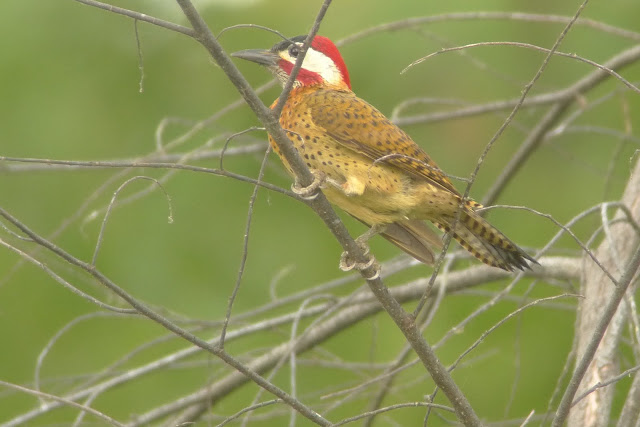
El fin de semana del 23 de abril estuvimos explorando las cercanias del Darién, Jan Axel Cubilla y Gloriela Archbold, José Carlos García y Mahelis Rodríguez, y Rafael Luck. Nuestro destino final era el poblado de Nuevo Vigía, pero desafortunadamente SENAFRONT no nos autorizo visitar esa zona por razones de seguridad. Una verdadera lástima, ya que personas del pueblo invirtieron tiempo y fondos para transportarnos y alimentarnos sin poder obterner los frutos de nuestra visita. De todas formas hicimos nuestro acostumbrado paseo con algunos de los resultados fotograficos: El Salto : Black-capped Donacobius en abundancia y Spectacled Parrolet Filo del Tallo : Black Antshrike , Cinnamon Woodpecker, Golden-headed Manakin (muchos hermits: long-billed, stripe-throated, pale-bellied , rufous-breasted) Puente del Río Mono : Rufous-winged Antwren, Barred Puffbird, Red-rumped Woodpecker, One-colored Becard .

Maroon-chested Ground-Dove and more in Boquete, a report by Rosabel Miró

The ongoing Audubon Panama/Boquete Birders fieldtrip to Boquete has been very productive so far. Yesterday we got 2 Quetzals, 2 Costa Rican Pygmy-Owls (one rufous, one brown), one Black-billed Cuckoo (very good sighting, they are VERY rare...) and several Elegant Euphonias , among other birds. We had a very nice weather, with some migrants (lots of Swainson's Thrushes, many Wilson's Warblers). We also had two sightings of Maroon-chested Ground-Dove . All these on the road up Volcan Barú. 

Veraguan Mango in Southern Veraguas, a report by Kees Groenendijk

Imagen
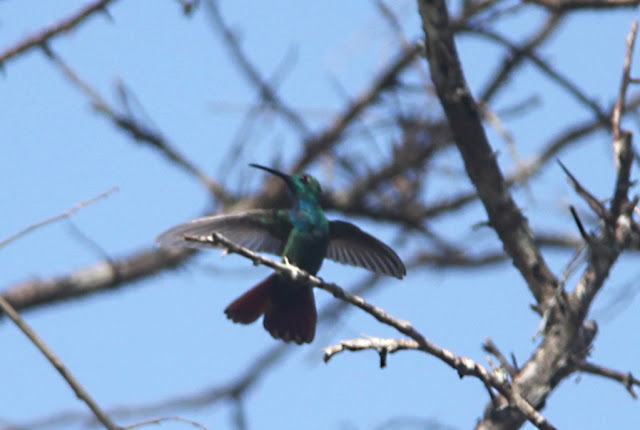
On 20 April, I went to observe macaws near Cerro Hoya NP with Juan Velazques. From our observation point (N7.35011, W 80.78059; decimal degrees, WGS84) we saw not only at least 15 Great Green Macaws , but also several hummingbirds. Our observation point was about 100 m above sea level, so to have Violet Sabrewings visiting flowers there was already somewhat unusual. Even more intereseting, though, was the presence of a Veraguan Mango . On the photo, you can clearly see the maroon rounded tail, all black downcurved bill and the dark blue stripe on the throat.