Thursday, May 24, 2012

Rarities and Anomalies in Parque Internacional La Amistad, a report by Michael Froude

A spontaneous visit to the Cerro Punta area in late April yielded the following notable observations in Parque Internacional La Amistad.
On 29 April, near the lowest point on Sendero El Retoño, at about 2170m I had an extended intermittent sighting through tangled foliage of a Streaked Xenops, behaving very similarly to the familiar Plain Xenops, including hanging upside down. I noted the obvious streaking, supercillary and malar stripes of the same colour compared with those of different colour of the Plain Xenops and with the supercillary only of the larger Ruddy Treerunner seen the previous day, also hanging upside down. I had another brief sighting of Streaked Xenops (maybe the same one) the following day in tangled foliage just below the park entrance, at about 2100m. These altitudes are higher than the range quoted by Angehr.
At the spectacular cascade which is the destination of Sendero La Cascada, at about 2400m, on 30 April, I saw an Ochraceous Pewee, on an exposed perch high above the pool at the foot of the cascade, making repeated hunting sorties and returning to more or less the same perch. Having seen a Tufted Flycatcher the previous day I could make the following comparisons: larger, less pronounced crest, duller ochre breast (the difference was more pronounced than suggested by the illustrations in Angehr), pink lower mandible.
My mild irritation at the restricted opening hours of the park (8 to 4) was more than compensated by sightings of Resplendent Quetzal in the relatively open area at the entrance on both mornings whilst waiting for the park to open. On 29 April a male perched high in a tree took flight just as I got my binoculars on him and I didn’t see him again. But on 30 April I saw (the same?) male and a female flying back and forth and perched over a period of about 20 minutes. Can birding get any better than the sight of a male Resplendent Quetzal in brilliant emerald, scarlet and white breeding regalia in full sunlight, flying across a vivid blue sky? A little later I had the bonus of a further sighting of the perched male from my breakfast table on the terrace of the agreeable ASAELA restaurant just inside the park gate.

Wednesday, May 23, 2012

More Avocets at Aguadulce

Venicio Wilson found a flock of eight American Avocets at Salinas de Aguadulce on May 15. These are different birds from the ones at Costa del Este, which are still hanging around.

Monday, May 21, 2012

The Costa del Este Avocets

Gwen Keller went shorebirding at Costa del Este yesterday afternoon and as the tide was coming in she spotted maybe 30+ Marbled Godwits, 9 American Avocets, some with rufous plumage, and a number of short billed dowitchers among the usual cast of characters.

Friday, May 18, 2012

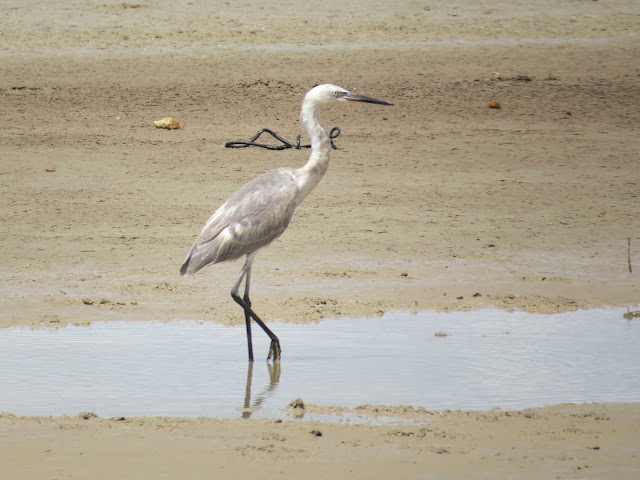
Capped Heron at Summit Gardens

Marianne Akers found this Capped Heron yesterday at Summit, wading in the crocodile pond (no crocodile present).

Monday, May 7, 2012

mixed bag: red-billed tropicbird, Veraguan Mango and more; a report by Kees Groenendijk

Kevin Easley and some other avid birders from Costa Rica visited the Western Azuero and Coiba with me. On 3 May we went to Changuale (East of las Flores) to try and find the Azuero parakeet. Wer did not find it, but saw many King Vultures circling above us while walking along the Pavo river. 
We left for Coiba on 4 May. Between Santa Catalina and Coiba we saw Red-necked Phalaropes, Brown Noddies, a juvenile Red-billed Tropicbird and a Parasitic Jaeger. On the Las Pozos trail on Coiba we found the Coiba Spinetail and the Brown-backed Dove. There was also a male Indigo Bunting in breeding plumage (The Angehr guide does not mention that Indigo Buntings occur on Coiba).
Furthermore, for the last three weeks, our hummingbird feeders are daily visited by a juvenile mango. I have attached a (small) picture of the bird. I think it is a Veraguan Mango.

Friday, April 27, 2012

That heron? Probably not a Lava Heron after all.

Panama Records Committee Chair George Angehr chimes in on Venicio’s odd Butorides from Las Bóvedas:

Interesting bird. However, I showed it to heron expert James Kushlan and he said that Lava Heron has a thicker bill and thicker legs. Photos on line also seem to show that Lava Heron has a yellow eye. Kushlan thought it was just a melanistic Green/Striated.

Wednesday, April 25, 2012

Lava Heron? A report by Venicio Wilson


Yesterday while walking Casco Viejo with a friend I spotted this "very dark" Green Heron on the rocks below Paseo Esteban Huertas at Las Bóvedas. I was looking at the picture I made with my cellphone and my binoculars (Binophonescoping) and the bird looks very similar to the pictures of Lava Heron from Galapagos Islands. With the high number of ships and sailboats crossing the Panama Canal there is a small chance for an accidental Lava Heron?

Saturday, March 3, 2012

Green Ibis near Portobelo


Zeke Jakub photographed this pair of Green Ibis near the bridge over Río Cascajal at Nuevo Tonosí, near Portobelo.

More and more avocets


And, as promised, here are better photos of the American Avocets at Costa del Este by Osvaldo Quintero.
Justo Camargo went looking for them yesterday afternoon and he reports seeing at least eight individuals. Avocets are a rare winter visitor to Panama, and this is the first record of a flock. Have you gone looking for them yet?

Friday, March 2, 2012

American Avocets (as in, more than one) at Costa del Este

While on a routine visit to Costa del Este this morning, Dr. Osvaldo Quintero discovered not one or two, but four American Avocets at the mouth of Río Matías Hernández. He checked a while ago and they are still in the area, so if any of you need this extremely rare winter visitor to Panama, go for it.
Better photos to come, for sure.

Gazetteer