Entradas

Mostrando las entradas con la etiqueta islas frailes

On the underwater topography of the southeast Azuero Peninsula

Imagen
First, for context, a colored bathymetric map of Panama. Zooming in, a simplified diagram showing the 200, 1000, 2000 and 3000 meter isobaths. Zooming in further, the Google Earth image showing two notable points of our September 11 deep water pelagic trip : our stops that produced Tahiti Petrel and Wedge-tailed Shearwater . These stops were not serendipitous, but were carefully planned atop seamounts, underwater mountains. The most productive one, 45 km east-southeast of Punta Mala, has its summit at 91 meters deep, but is surrounded by 1000-meter depths. The Wilson's and Wedge-rumped Storm-Petrels were seen about halfway to that spot, maybe at 300 m depths. We suspect the other mound, with a 37-meter deep summit was not in deep enough waters (around 500 m). There is a third seamount, about 45 km west-southwest of Punta Mala, also at the 1000 m isobath, that remains unexplored. Heading in that direction would allow us to swing by Islas Frailes, as a bonus. Finally, some eye cand...

Islas Frailes report. Unrelated: Reddish Egret

Imagen
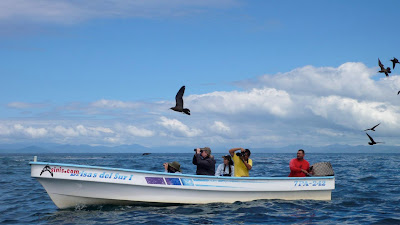
On Saturday, August 7, Claudia & Bill Ahrens, Rosabel & Karl Kaufmann, and Delicia & Darién Montañez braved the threatening skies over Pedasí and headed out for Islas Frailes. Frailes del Sur were covered in birds: about 500 Bridled Terns , including some in juvenile plumage, maybe 200 Brown Noddies, and 100 Sooty Terns , including some 25 in juvenile plumage that would often fly over our boat. Further out, and after deploying the chum, we started running into procellariids: one or two Galápagos Shearwater , a single Sooty Shearwater and a dozen Wedge-rumped Storm-Petrels . Our persistence was rewarded when we approached a flock of noddies and ran into about 120 Galápagos Sheawaters sitting on the water, allowing for really close views. Of course, I completely forgot I had a camera on me. After this flock flew and floated away, we went out some more and found another similar flock, this time with about 80 Galápagos Shearwaters, similarly well-behaved. Our boatman estimated...

Avistamientos interesantes, a report by Jan Axel Cubilla

Imagen
Sólo quería compartir algunos avistamientos que Gloriela y yo hemos realizado desde el pasado fin de semana. Antes de encontrarnos con el grupo de participantes de la gira de campo de la SAP a Santa Fe, fuimos en horas de la tarde del viernes 17 de julio a las ciénegas de Las Macanas (Herrera). Sólo a destacar la presencia de al menos tres Aplomado Falcons a lo largo de la carretera nacional y otro (fotografiado) en la vía de acceso en las Macanas. El tiempo en Santa Fe no nos favoreció (mucha lluvia). Aún así pudimos llegar hasta cerca de la divisoria continental. Cerca del sitio de construcción de la nueva sede del PN Santa Fe en la carretera Alto de Piedra - Guabal (apenas en la vertiente pacífica) nos encontramos con una bandada mixta de tangaras conformada principalmente por Dusky-faced Tanagers con las cuales viajaba un sólo individuo de Ashy-throated Bush-Tanager (luego envio la documentación completa). Varios miembros del grupo pudimos observarla (inclutendo a Gloriela y ...

Petit Comité Pelagic

Mike Mulligan and Darién Montañez spent the morning of June 20 out beyond Islas Frailes hoping a pelagic bird or two would approach. A gorgeous, non-glary day with still waters and no wind provided excellent conditions, and allowed us to see floating shearwaters from far, far away. We must have had about 15  Galápagos Shearwater sightings, some floating obliviously about two meters away from our boat, but most flying around (we like to think attracted to our meager chumming efforts). The ones that definitely (perhaps) came in to our canned-tuna slick were the Wedge-rumped Storm-Petrels, of which we had about 30 different sightings throughout the morning. We also had a Pomarine Jaeger fly by, paying no attention whatsoever to us. No other species of shearwater, storm-petrel, or jaeger were seen. Islas Frailes themselves were, as reported by our captain, full of birds. Two to three hundred Bridled Terns, about one hundred Sooty Terns, and about three hundred Brown Noddies stoo...

PAS Fieldtrip to Islas Frailes. NOT a new species for Panama

Imagen
The Panama Audubon fieldtrip to Islas Frailes of Saturday, March 14 2009 was slow, as usual, but productive, also as usual. We spent about 6 hours on two boats, most of the time about 15 miles offshore. Most notable were the absent species: not a single Brown Noddy was around, and we usually see many hundreds of these. Also, both Frailes and Monjas were almost completely devoid of birds, a first in the 8–10 times I’ve been there. No Sooty or Bridled Terns were seen in either island; a couple boobies was all there was. We also didn’t see any Storm-Petrels, but we’re blaming this on bad chumming on our part. The bird of the day was a mystery bicolored shearwater, larger than Galapagos Shearwater, of which we saw a pair rather close to the boats and then a more distant single bird. Originally called out as Wedge-tailed Shearwaters, a species neither myself nor Jan Axel Cubilla on the other boat has had experience with, but which at least seem to be in season in Costa Rica. Back to land w...

PAS Fieldtrip to Islas Frailes.

Imagen
On the morning of Saturday, September 6, eight Panama Auduboners braved the ominous, overcast skies and headed out to sea for a morning of pelagic birding on our yearly fieldtrip to Islas Frailes del Sur. We headed straight out, saving the islands for the way back. On the way out we saw the first of many Wedge-rumped Storm-Petrels, which were not seen on our July scouting trip. At the end of the day we were up to 16 wedge-rumpeds, with a single, unidentifed storm-petrel with a dark rump. We stopped about 20 km offshore and drifted for a long, seasickening while, while trying to lay a good, smelly oil slick to try and lure something in. Sure enough, not an hour had passed when we had a Sooty Shearwater fly in and look around for a bit before continuing on its shearwaterly business. We then wandered about aimlessly to get some fresh air on our green faces and found an unidentified phalarope and two more wedge-rumped storm petrels sitting on the water. Eventually we approached Frailes ...

Mixed Bag, from Ben Lascelles

Imagen
Ben Lascelles sent in the highlights of his two-month stay in Panama: 10th June - A Colombian race American Kestrel in Parque Metropolitano. 16th June - At El Copé treated to some fine views of Black-crowned Antpitta, with one by the visitors centre being particularly approachable down to just a couple of metres, wished I'd had some meal worms! Also saw female Snowcap and Spotted Barbtail. 19th June - Spectacled Owl with a large chick at Old Gamboa Road, also 2 Capped Herons on Summit Ponds 28th-30th June - Around Birders' View, Cerro Azul. Stripe-cheeked Woodpecker, Black-eared Wood-quail and Violaceous Quail-Dove (both heard only.) The Blue-fronted Parrotlet nest fledged the days we were there, with 2 young seen to leave the nest and at least one more heard inside still. 4th July - Rainforest Discovery Centre, Pipeline Road. Great Black Hawk, and male Tiny Hawk. 12th and 13th July - Haven't seen a report from the Panama Audubon Society trip to Santa Fe, so here are a...

PAS Fieldtrip to Islas Frailes.

Imagen
On Saturday, May 20, a select crew of hardy Panama Audubonites (Bill & Claudia Ahrens, Solange Anchor, and Darién and Delicia Montañez) braved the calm seas and crisp, beautiful rainy-season weather for an afternoon of seabirding around Islas Frailes. A harbringer of the exciting things to come, casual pre-lunch scanning from Venao Beach produced about five Bridled Terns and ten Brown Noddies mixed in with a small flock of Black Terns. Later, when walking down to the boat that we would call home for the following four hours, we found three Elegant Terns with the Laughing Gulls, two flying and one standing on the beach. Things got more interesting once we were about 2 km offshore, with the appearance of a largeish, all-dark Storm-Petrel that we're calling a Black Storm-Petrel , as well as numerous Bridled and Sooty Terns and Brown Noddies , some carrying fish. Frailes del Sur were covered in birds, most likely nesting. The population of the bigger, southern island was very ...