Entradas

Trip report by Ariel Aguirre
Imagen
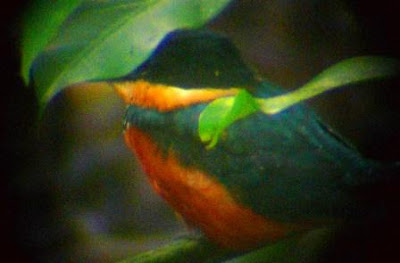
These are the highlights of a 10-day Birding Trip. I led from March 5th to March 16th March 6th —Early afternoon 1.5 km walk north from Quebrada Juan Grande at Pipeline road. We spotted Spot-Crowned Antvireo (Male & female), Brownish Twistwing, Thrushlike Schiffornis and a Green-and-Rufous Kingfisher hidden in the foliage at a small pond. March 10th —We had a Green-crowned Woodnymph and Ornate Hawk-Eagle on flight at Narganá Forest Reserve. March 11th— Slate-throated Gnatcatcher and Sulphur-rumped Tanager on a mixed flock at Narganá Forest Reserve, a Bare-throated Tiger-Heron seen hidden in the grass at the Bayano River Bridge. March 12th— Pheasant Cuckoo and a Bat Falcon couple seen at the Escobal Road, 2 km before the Achiote Road turn off. Also a White-headed Wren and a Rufous-crested Coquette at a side trail 300 m from the first bridge at Achiote Road; Later that same day a...

PAS Fieldtrip to Islas Frailes. NOT a new species for Panama

Imagen
The Panama Audubon fieldtrip to Islas Frailes of Saturday, March 14 2009 was slow, as usual, but productive, also as usual. We spent about 6 hours on two boats, most of the time about 15 miles offshore. Most notable were the absent species: not a single Brown Noddy was around, and we usually see many hundreds of these. Also, both Frailes and Monjas were almost completely devoid of birds, a first in the 8–10 times I’ve been there. No Sooty or Bridled Terns were seen in either island; a couple boobies was all there was. We also didn’t see any Storm-Petrels, but we’re blaming this on bad chumming on our part. The bird of the day was a mystery bicolored shearwater, larger than Galapagos Shearwater, of which we saw a pair rather close to the boats and then a more distant single bird. Originally called out as Wedge-tailed Shearwaters, a species neither myself nor Jan Axel Cubilla on the other boat has had experience with, but which at least seem to be in season in Costa Rica. Back to land w...

Pied Water-Tyrant at mouth of Río Pacora, a report by Matt Miller

Oscar López, Alonso Santos and myself saw several Fluvicola pica inside the borders of the mangroves near the mouth of the Pacora this morning. They were feeding along side Charadrius minutilla (also inside the mangrove forest?!?) at swarming flies over the mud. Tide was at its absolute high. Other migrants included several species of Tringa, Himantopus, Charadrius semipalmatus, but in general, migrant numbers seemed low. I should note that this is not a very nice site to bird, as the habitat is quite unattractive and scores of men work all day as paleros shoveling sand for the cement companies. We've had stuff stolen from our truck on earlier trips. I should probably mention that there was a lone Tachybaptus dominicus and several Tyrannus dominicensis a bit in towards Felipillo at this site back in mid-February, along with a lone Herpetotheres cachinnans.

Golden-green woodpecker at Cana, a report by Euclides Campos Cedeño

Imagen
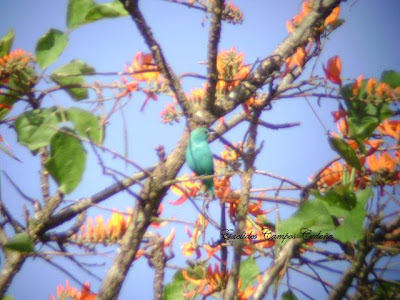
A calling Golden-green Woodpecker was heard on February 4th at Boca de Cupe trail, off the Cana airstrip. It responded to playback, and a male was seen by me and Daniel Gruneberg from England. And this male Viridian Dacnis male was photographed close to the Cana camp on February 2th.

Red-footed Booby at Swan Key

Imagen
Euclides Campos, leading a group of Canadians, found this dark-phase adult Red-footed Booby at Swan Key on January 29th. Even behind its branch, the red feet are visible, as is the blue-gray bill tip and white tail. We arrived at the island around 9 a.m. where the usual suspects were present, Brown Boobies and Red-billed Tropicbirds, but while scanning the rocky formation I spotted the bird. Photos of the Red-footed Booby are courtesy of the tour leader Rand Rudland. Red-footed Boobies are apparently regular off the Caribbean coast of Panama, with a few sightings from the mainland (see November 2007 report from Donoso) but this is the first report I'm aware of from Swan Key, definitely a heavily-birded site by Panama standards.

Crimson-bellied Woodpecker in Cerro Azul

Frank Gray and Glen Sibbald sent in this report for a Crimson-bellied Woodpecker seen at Cerro Azul's Río Mono trail. Date of observations: January 2, 2009 Observers: Frank Gray and Glen Sibbald Time of Observation: About 2:55 pm Panama time Location of Observations: GPS coordinates N 0922527, W 07943027, Rio Mono Trail, Altos de Cerro Azul, Panama. I don't know the elevation at that location, unfortunately, but I am sure that it can be determined. Weather Conditions: Partly cloudy, no rain or drizzle, no wind Identifying Characteristics: Was a large woodpecker, about the size of the Pileated Woodpecker of North America or slightly smaller. It had a red crest and a white strip on the side of the head. The belly was a rusty red color just like in the "Birds of Panama" book. Miscellaneous aspects of Observation: The bird was first seen by Glen as both of us were walking back towards the entrance of the Rio Mono Trail. He observed the bird for about 1 min...

Costa del Este

Imagen
Jan Axel Cubilla visited Costa del Este at high tide on February 8 with Osvaldo Quintero, who photographed the group of Black Skimmers that has been haunting the area. On the 12th, Jan Axel returned and found at least four Herring Gulls, a Ring-billed Gull and a Franklin's Gull as well as the skimmers among the hundreds of gulls, and some Red Knots among the hundreds of shorebirds present. Then on February 17 Itzel Fong visited Costa del Este, where she photographed the skimmers and a handful of Marbled Godwits.

Black-capped Pygmy-Tyrant Nest

Imagen
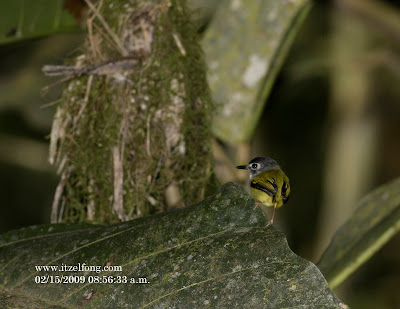
Itzel fong photographed this nesting Black-capped Pygmy-Tyrant in Pipeline Road. The spot, on an uphill beyond Quebrada Juan Grande, is marked with three stones tied with pink flagging tape.

Mangrove Cuckoo in Dolega

After reading about the Coiba Mangrove Cuckoo, Olmedo Miró reports having seen one last week near Dolega, Chiriquí, at about 200m elevation. Mangrove Cuckoo, which may breed in Panama but is recorded more often during the boreal winter, seems to be all over the place this year.

More from Coiba

Imagen
Rafael Luck sent in these photos taken during the Panama Audubon Society fieldtrip to Coiba National Park of January 23–25, including possibly the first Mangrove Cuckoo reported from the island, as well as the ubiquitous Scarlet Macaws and a flock of Sanderlings.

Chiriquí and Bocas Bonanza, a report by Euclides Campos Cedeño

Imagen
During the first weeks of January, I spent a few days birding in the Chiriquí highlands and foothills of Bocas del Toro with some friends, looking for some of the Talamanca range endemics. On January 5th a male Masked Duck and a Masked Yellowthroat were seen at Volcán Lakes. The next day we had a White-fronted (Rough-legged) Tyrannulet on the way to the ANAM headquaters at Respingo, where we saw a Costa Rican Pygmy-Owl close to the main building. On January 7th a single White-throated Flycatcher (juvenile) and two Bran-colored Flycatchers at Volcán Lakes. The following day we moved to Rancho Ecológico Willy Mazu. The birding was superb around the area yielding White-crowned Manakin on 8th; Lanceolated Monklet, Ashy-throated Bush-Tanager, Dull-mantled Antbird, plenty of Yellow-throated Bush-Tanagers, a Black-headed Antthrush (heard only) and a good bonanza for the day: a male Bare-necked Umbrellabird on the 9th. On 10th at the Verrugosa trail, Ochre-breasted Antpitta almost...

Ruby-throated Hummingbird in Coclé, with bonus Blue-throated Toucanet, a report by Carlos Bethancourt

Imagen
On January 30 We went to El Chirú, where we had a brilliant day of birding! First we all got excellent views of Ferruginous Pygmy-Owl and Tropical Screech-Owl... In the same area we have close views of the endemic Veraguan Mango, as well as Crested Bobwhite, Saphire-throated Hummingbird, Red-breasted Blackbird, Rufous-browed Peppershrike... After a great morning we went to Juan Hombrón where we had perfect views of Straight-billed Woodcreeper, Mouse-colored Tyrannulet, Northern Scrub-Flycatcher.... The most amazing thing for us during the day was a Ruby-throated Hummingbird, which is a rare migrant for Panama especially in the Coclé Province. We saw this bird, a juvenile, at El Chirú. Tino Sanchez (Canopy Lodge Top Guide) and I got great views of it. I had the close telescope views so I could see the bright red gorget. We could not take a picture there, but every one in the group got to see it. Once in Juan Hombrón I found another Ruby-throated but this one has less red on the gorg...