Entradas

Bare-throated Tiger-Heron in Bocas del Toro, a report by Pat Wade

Imagen
Greg and Eileen Meyer of Santa Cruz, CA were recent visitors to Isla Colon. Greg had contacted Pat Wade, a resident of Boca del Drago, through Birding Pal about doing some birdwatching during their stay on Isla Colon. While boating down the old banana canal between the Drago cut and the Changuinola River on Feb. 17 they sighted and photographed a Bare-throated Tiger-Heron. The bird was seen about 1 km from the entrance of the canal. According to Angehr and Dean's field guide, there has been only 1 other report of this bird on Panama's Atlantic coast, and that was from the easternmost part of the coast.

Ruby-throated hummingbirds in Mariato, a report by Kees Groenendijk

Imagen
Over the last few days we have been seeing a few unusual humminbirds in our garden (just south of Mariato, on the western side of the Azuero Peninsula). Today I finally managed a (not very good) picture of one of them. And managed to identify it as a Ruby-throated Hummingbird . Even on this picture you can see the beginnings of the ruby throat. So this is a first year male. There is another individual of the same species with a more developed ruby throat. [Ruby-throated Hummingbird is a regular winter resident in western Chiriquí, with a few records from southern Coclé. This may be the first record from Veraguas].

Gray-cheeked Thrush en Cerro Jefe, un reporte por Rosabel Miró

Imagen
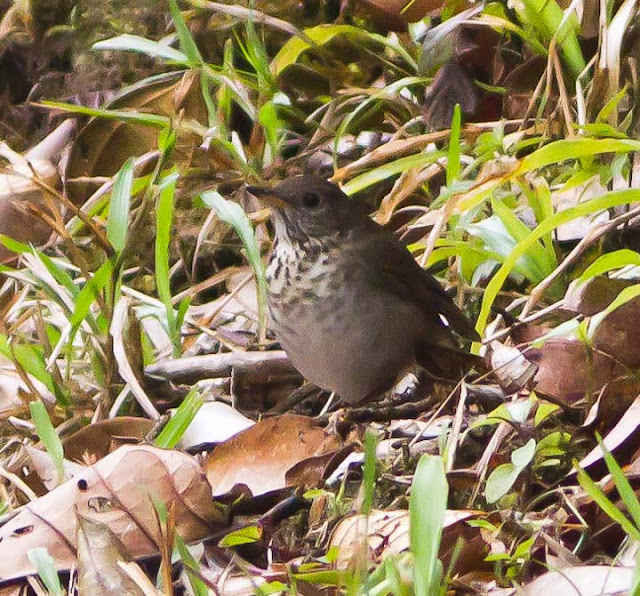
Este Gray-cheeked Thrush lo vimos el viernes 10 de febrero, como a eso de las 10 am, ya casi llegando al sendero del Xenornis, en la última loma que lleva a ese lugar, en Cerro Jefe. Lo observó primero Bea Roy y estábamos con ella Sue Chamberlain, Karl y yo. Estaba en el piso, en lo que parece alimentándose de insectos. Tenía años que no veía a uno y es primera vez que veo esta especie en Cerro Jefe.

Birding Cerro Colorado, a report by Bill Adsett

Imagen
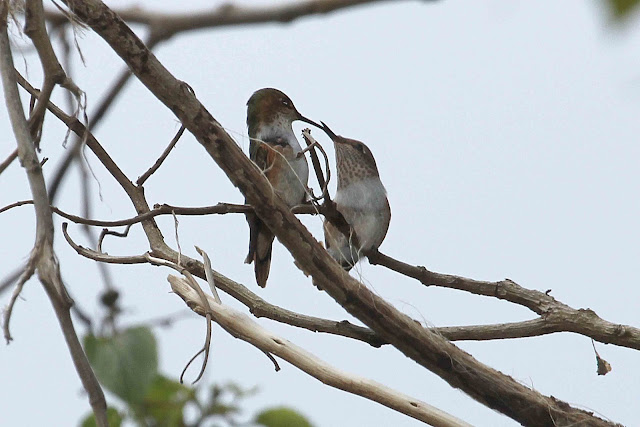
I spent 4 days in the Cerro Colorado area from 23 to 26 January with Ramón Pineda Jr as guide. Most notably, we found a young Glow-throated Hummingbird ( Selasphorus ardens ) being fed by its mother, both of which were photographed. I base the identification as Glow-throated mainly on location (4km east of Cerro Flores on the new road to Llano Tugrí, at 1250m) and the white bellies of the birds. According to all books and my own experience, the Scintillant is not found to the east of Cerro Flores, and according to Ridgely, the very closely related female Scintillant Hummingbird ( Selasphorus scintilla ) has a cinnamon belly. My theory after several visits is that the dividing line between the ranges of Scintillant and Glow-throated Hummingbirds is the ridge that separates the San Félix and Tabasará river basins. Cerro Flores forms part of that ridge. The “main” road to Cerro Colorado runs more or less up that ridge, then turns off it slightly to the west at about 1500mt and aft...

New for Panama: Gray-bellied Hawk, a report by Venicio Wilson

Imagen
On February 9th of 2012, at 7:17 AM while guiding a birding program for Sendero Panama, we spotted a raptor on top of a Cuipo tree near the road in the way to El Salto, Darien. The bird was very similar to a Bicolored Hawk but inmediatly I noticed the paler gray on the belly and the lack of rufous on the thighs. Immediately our guest, Larry Wan took his 500mm camera and made several pictures of the bird which are the ones posted here. I also remembered a 2008 report of an immature Gray-bellied Hawk in Costa Rica and started pointing at the differences between both hawks. The lack of rufous on the thighs, the paller grey in the chest and belly, the contrast between black crown and dark cheeks were the immediate marks we noticed. While Larry and Sara were making pictures and observing the bird, I got to hear the bird call: 6 or maybe 7 notes, high pitch, 1 1/2 seconds apart from the other. I have heard and seen several times Bicolored Hawk in Bocas del Toro and this bird was lighte...

Breaking: One Jabiru in Chiriquí Grande. And then another.

Imagen
 As you read this, Jacobo Ortega is in Chiriquí Grande seeing the second Jabiru of the day. The first was seen from the main road on the fields on the south side, near the oil tanks up in the mountain.  The second one (photo below) was seen further out, also from the main road. Who's up for a flash trip out there?

The hunt for the Grasshopper Sparrow

Imagen
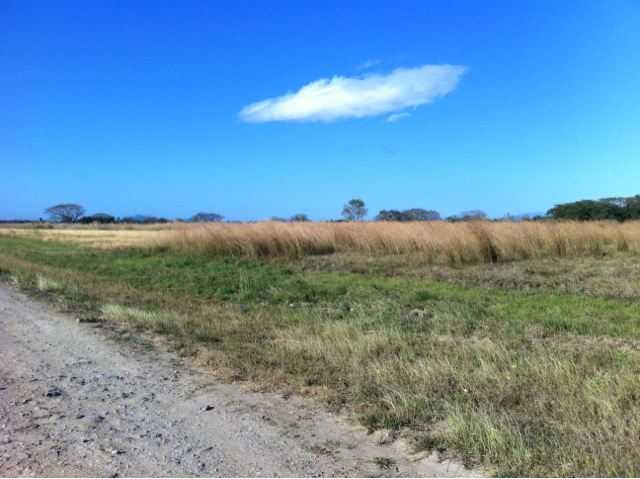
Success, pretty much. This morning, Jan Axel Cubilla, Venicio Wilson, Rafael Luck, Osvaldo Quintero, and Camilo and Darién Montañez converged upon the fabled spot near Penonomé to look for the Grasshopper Sparrow, unrecorded in Panama for fifty years. The spot, shown on the map we tweeted earlier , is on a dirt road on the left side of the Interamericana a bit over 6 km past the Penonomé McDonald's. About 100 meters in, there is a patch of short, green grass on the right shoulder of the road, and that's both where Jan Axel found the bird last Saturday and where we saw it today. Repeatedly. Very briefly. The first sighting was shortly after we parked at the spot: Osvaldo walked ahead of the cars and the sparrow flushed from the grassy shoulder into the field beyond, landing on a patch of short grass surrounded by taller grass. We followed, but hard as we looked we couldn't find it. It flew back to the shoulder, where it remained unfound until it flushed a few inches from my...

Grasshopper Sparrow (!!!) near Penonomé, a report by Jan Axel Cubilla.

Imagen
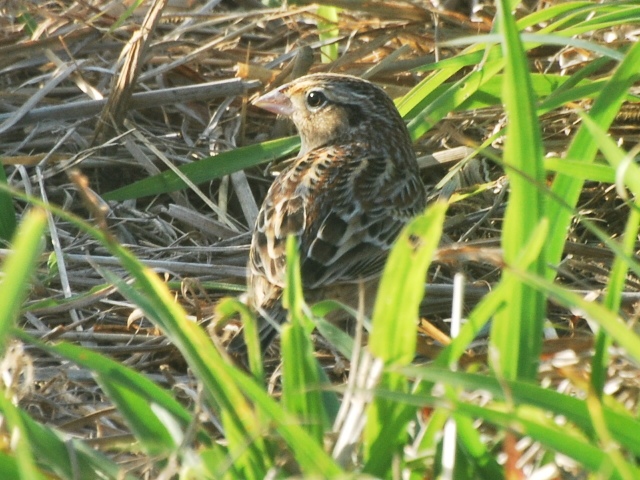
I just came from a short walk in the Cocle savana following the directions gave by Ken last year to find the Ring-necked Ducks close to Cocle town, 5 min west of Penonome (second dirt road to the left after the "push buttons"). After seeing the ducks (lifer), I was about to leave the place, more or less 300 mts from the Panamerican highway (I was able to see the cars in the highway), when I detected a movement right next to the car. It looked like a mouse, walking very low, even crawling under the grass, but eventually frooze no more than 4 mts from my car. It stayed for 5 minutes, only moving very quickly few steps to stand again. It didn't vocalize, not even a chip. I took plenty of photos... but I was not able to see its breast... I wonder if someone knows how to separate the migrant Grasshopper Sparrows in the field... I hope it is of the endemic race, thought to be erradicated due to habitat loss. [More details on the sighting  at Jan Axel's blog .]

Grasshopper Sparrow rediscovered?

Breaking: Jan Axel Cubilla found a Grasshopper Sparrow near Penonomé earlier this afternoon. He went looking for the Ring-necked Ducks that Ken Allaire had found, and he stopped on a field on the way back, on one of the new roads opposite the push buttons. He was looking at some meadowlarks, when he saw a tiny bird running like a mouse. This is the first record in eons of Grasshopper Sparrow, a near-mythical bird in Panama. Photographs were taken, too, so we'll hopefully determine if this bird was a migrant or if it's a surviving member our local subspecies that has been presumed extinct. I'll try for it tomorrow, but there will probably be a full fledged expedition next weekend. Study up!

Snail Kite en Albrook, un reporte por Rosabel Miró

Imagen
Acabo de tomar esta foto, 11:20am. Esta hembra está posada en la recta que va detrás de El Rey de Albrook al área residencial, cerca del cuadro de beisbol y la piscina.

Lesser Black-backed Gull in Panama Viejo, a report by Rosabel Miró

Imagen
Rosabel Miró photographed this large gull, most likely an adult Lesser Black-backed Gull , last Thursday, December 1, at 7:11 am whilst with a group of shorebird monitorers in Panama Viejo.

Clay-colored Sparrow at San Lorenzo, a report by Sue Osier

Imagen
I found a Clay-colored Sparrow at Fort San Lorenzo on December 3, 2011. It isn't on the listed on the species list for I have for Panama and I'm not sure if one has been seen here before. I saw it at 4:52 p.m. in a Hibicus rosa-sinensis overlooking the Chagres River near the ruins of Fort San Lorenzo. I had my back to the ruins and it flew from behind me and into the Hibiscus . I got it in my binoculars and realized I needed some photos. I got four pretty bad shots and when I had the camera up, it flew off. I didn't see where it went and couldn't locate it again. [This would be, indeed, the first record of Clay-colored Sparrow in Panama. Clay-coloreds normally winter in Mexico, rarely as far south as Chiapas.]