Entradas

Mostrando las entradas con la etiqueta least tern

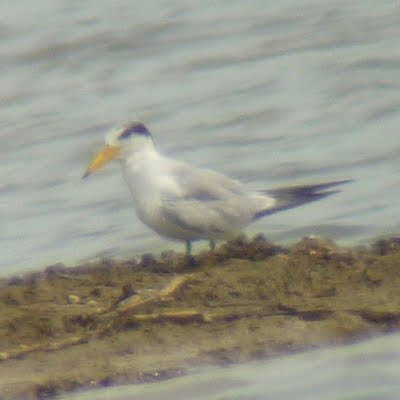
Is this a Yellow-billed Tern?
Imagen
Euclides Campos and Laura Reyes found this odd tern at Aguadulce salinas on September 20. The bird was with a few first-year Least Terns, but was clearly different. For one thing, it had a yellow bill (hint, hint). The gray crown and unmottled gray back on this bird show it to be an adult in basic plumage. The bill of a non-breeding Least Tern is all-black, but would be yellow and dark-tipped on a non-breeding Yellow-billed Tern, a vagrant from South America that has been recorded in Panama a few times, with records from Aguadulce and El Agallito (but has never been photographed, as far as I know). This bird's bill also seems too heavy for Least, but it lacks the dark area around the nostrils that basic-plumage Yellow-billed Terns should have (see Cotinga 15:10–13 and the identification essay on the Southeastern Caribbean Birds Photo Gallery ). So what do you think? Do we have photo documentation of Yellow-billed Tern in Panama or is this a Least Tern with a freaky bill? Do chime...

Elegant Terns at El Agallito

Delicia and Darién Montañez found small flock of terns at the water's edge at Playa El Agallito, Chitré, with two Elegant Terns, one in breeding plumage, and about two dozen Common Terns in various plumages. On another spot there was a smaller flock of a dozen Least Terns, one of which was in breeding plumage.

PAS trip to Costa del Este

The PAS fieldtrip to Costa del Este could not locate any Long-billed Curlews, but had a Lesser Black-backed Gull, most likely the same individual that was seen the previous thursday at Paitilla. Also seen were Upland and Stilt Sandpipers, Least and Caspian Terns, and small flocks of migrating Mississippi Kites.

Yellow-billed Tern at El Agallito

A Yellow-billed Tern was seen in a flock of a hundred Least Terns at El Agallito, Chitré. A Yellow-billed Tern was seen in a flock of a hundred Least Terns at El Agallito Beach, Chitré, on Sunday, April 19th, by Delicia, Darién and Camilo Montañez and Zeke Jakub, a young ornithologist from Massachusetts. The bird was observed for two to three minutes from a distance of about five meters. It was standing in the mud in front of the group, so it was easy to pick out among the other terns. Its bill was noticeably longer and stouter at the base than that of the Least Terns, and its color was brighter and slightly paler, with no hint of dark near the tip. Since it was standing right next to a hundred Least Terns these differences were even more striking. It had an all-black crown and nape, and the white on its forehead extended back over the eyes forming a thin supercilium, which was absent from the rest of the terns in the group, even those in full breeding plumage. It also seemed to be dar...