Entradas

Mostrando las entradas con la etiqueta fort sherman

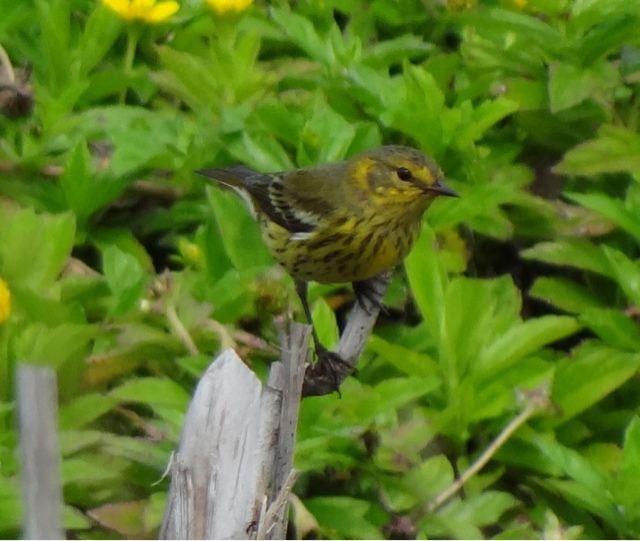
Cape May Warbler in Fort Sherman, a report by Suzanne Osier

Imagen
Hello, I thought I should write and let you know I found a Cape May Warbler at Fort Sherman/Shelter Bay Marina, this morning.

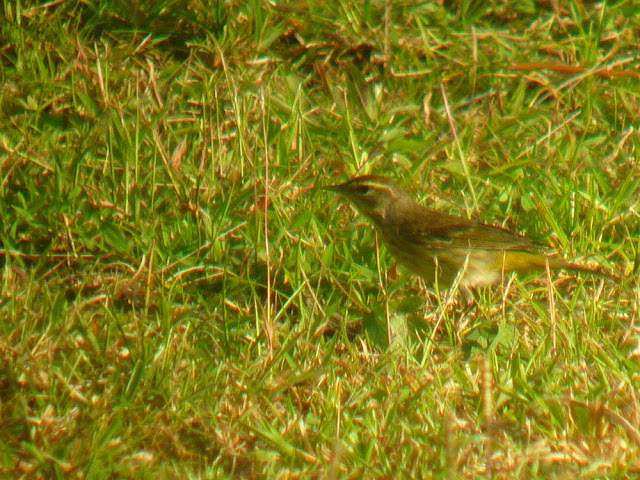
Palm Warbler in Fort Sherman, a report by Octavio Ríos

Imagen
The past March 17th 2011, leading a group around Fort Sherman at San Lorenzo National Park, we saw a couple of Palm Warblers on a road that goes from Shelter Bay Marina entering the former Post Theater and Church. This road goes to a set of barrack stile housing and in bethween there is a large loop with low grass land. There we saw two of them feeding very actively.

Variegated Flycatcher: a species new for Panama

Imagen
Suzanne Osier, an amateur birder currently living in Panama aboard her sailboat, photographed this Variegated Flycatcher in Fort Sherman on January 18, 2010. The bird was found at Kennedy Loop, the open area beyond the old cinema (or was it a church?) where the Lined Seedeater was seen that one time. Ex marks the spot: This bird's shape, long and lean, doesn't match the typical Streaked Flycatcher or Piratic Flycatcher, the common streaky flycatchers in the area. All the distinguishing marks for Variegated are visible in the photos: olive-brown back, rufous rump and tail edgings, bold white edgings on the wing coverts, pink base to the mandible, and mottled-streaked underparts.  Variegated Flycatcher ranges into Northeast South America, but its southern populations are migratory and are known to sometimes overshoot their winter destination. There are records from the United States and Canada, so it's not totally surprising to find one in Panama (especially at Fort Sherma...
Mixed Bag

Imagen
Carlos Bethancourt also forwarded these two photos from José Pérez: a Speckled Mourner seen on Pipeline Road March 3 and Mangrove Cuckoo seen March 4 at Fort Sherman.

Dark-eyed Junco at Sherman

Imagen
Delicia and Darién Montañez happened upon a Dark-eyed Junco while christmasbirdcounting on Fort Sherman. The bird looked like a slate-colored female (or juvenile): pointy pink bill, slaty head and neck (darker around the lores), white belly and vent with slaty flanks; the crown and back were brownish gray, and the dark-slate tail had very prominent outer rectrices, which the bird flashed conspicuously while in flight. These white flashes were what first caught my eye as the bird flew towards me across a field (hopefully in response to my fierce pishing). It perched on a tree about three meters over the road and preened for two minutes (enough time for Delicia to arrive). It then flew back across the field and perched atop an old chain-link fence, then dropped to the grass and hopped around for a minute before flying off towards some abandoned shed. It didn't seem to pay much attention to the small flock of Variable Seedeaters that was feeding nearby, and came and went as it saw fit...

And one more thing...

A weird bird was seen perched on one of the fences at Fort Sherman: it looked like a cross between an Indigo Bunting and a Yellow-breasted Flycatcher. It was larger than a bunting, with a pink conical bill (in shape similar to that of a siskin, not of a seedeater), dull yellowish olive all over, faint dusky streaks on the sides of the chest, pale yellowish in the belly. It looked very slim and had a long notched tail that was pumped up and down while perched. Its jizz was all wrong, and it did not recall anything i had ever seen in any book. Perhaps a canary or serin. So any hints about the possible identity of this new, most likely ship-assisted addition to the Panama list would be very much appreciated.

European Starling at Fort Sherman

Ken Wysocki and Steve Huggins, visiting birders from Chicago, and Darién Montañez discovered an adult European Starling in winter plumage at Fort Sherman, Colón. The bird was first seen at 2:30 P.M. on the grass just beyond the Shimmy Beach fence behind the last of the row of houses. The bird was walking near (but not with) a few Great-tailed Grackles, and was observed both on the ground and in flight for about 20 minutes. Apart from its white spots, the smaller size, shorter tail and more vertical stance gave it a completely different jizz from that of any other Panamanian bird, making it almost impossible to misidentify, and it should be easy to pick out from even the biggest blackbird flock. This is only the second report of Starling in Panama, the previous one being of another single adult seen twice at Albrook in February of 1979. This bird did not seem to be particularly tame (it flew off when approached) or starved (it did not rush to feed on the Pringles offered by the observer...