Entradas

Mostrando las entradas con la etiqueta white-rumped sandpiper

Hudsonian Godwit en Sarigua, un reporte por Rosabel Miró

Imagen
El viernes 13 de octubre en la mañana, regresando de de un taller en Volcán, paramos en el Parque Nacional Sarigua y encontramos un Hudsonian Godwit . Hay muchas camaroneras por el área y varias tinas vacías, con algo de agua algunas. Habían también muchos Lesser Yellowlegs , 150. No nos había tocado ver tantos. Camino a Volcán paramos en Aguadulce y allí vimos muchos Stilt Sandpipers : 79, un número grandote. En la entrada de El Rincón de Santa María estaba un tractor removiendo la tierra y detrás del tractor contamos 806 Glossy Ibises , el número más grande que hemos tenido a la fecha. Parece que a esta especie le está yendo muy bien por allá. Este White-rumped Sandpiper  también andaba por ahí...

White-rumped Sandpipers in Panamá Viejo

Imagen
Rosabel Miró and WHSRN's Rob Clay were at Panama Viejo for this morning's high tide and they found a total of 7 White-rumped Sandpipers mixed in with the Western Sandpipers and Short-billed Dowitchers. 

Mixed bag, a report by Euclides Campos

Imagen
White-rumped Sandpiper seen at Punta Chame on October 30th. Two white morph Reddish Egrets were observed at Punta Chame on November 6th. Lesser Black-backed Gull (adult) seen at Costa del Este on November 10th.

More on the Punta Chame White-rumped Sandpiper

Imagen
Euclides Campos sent in two additional photos of the White-rumped Sandpiper he saw at the former shrimp ponds on Punta Chame last Thursday, September 3. Besides showing the typical elongated silhouette (with primaries that extend well beyond the tail), the bib now looks good for an adult bird. The streaked flanks and pale base to the mandible are there if you squint, and Euclides even saw the white rump when the bird took flight.

Sandpipers at Punta Chame

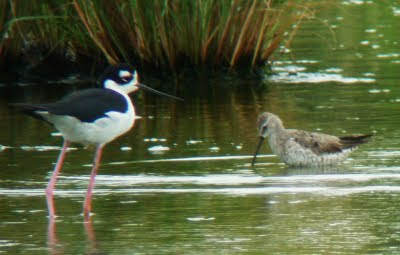
Imagen
Euclides Campos sends in two interesting photos of interesting sandpipers taken at the former shrimp farms at Punta Chame. The first one shows two stilts: a Black-necked Stilt and a Stilt Sandpiper. Can you tell which is which? Notice especially the typical sloping forehead and pronounced, rounded crown. We say the sandpiper is an adult molting into basic plumage (fide the remains of barring in the underparts and the few leftover black feathers in the mantle and scapulars). Then there's this bird, seen foraging with Semipalmated Sandpipers. It was identified in the field as a White-rumped Sandpiper (and the jizz seems right for that), but the chest seems too dark even for a juvenile. What do you think, freak lighting effect or Pectoral Sandpiper? Click on the photos for full size and chip in (via the comments). [Update: consensus seems to lean strongly in favor of White-rumped Sandpiper]

Pacific Christmas Bird Count highlights

White-rumped Sandpiper at Rodman Ponds (Bill Porteous), Long-billed Curlew at Panamá Viejo (Rosabel Miró), Laughing Falcon, American Pygmy Kingfisher and Speckled Mourner at Old Gamboa Road (Darién Montañez), Slaty-backed Forest-Falcon and Pheasant Cuckoo on the Madden Road side roads (Loyda Sánchez)... (more coming soon).