Entradas

Mostrando las entradas con la etiqueta spotted rail

Expedición a Darién, un reporte por Howard Laidlaw

Imagen
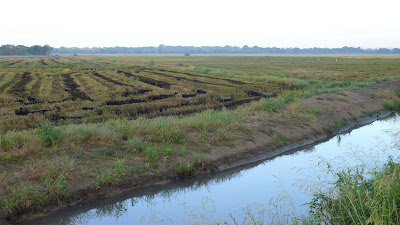
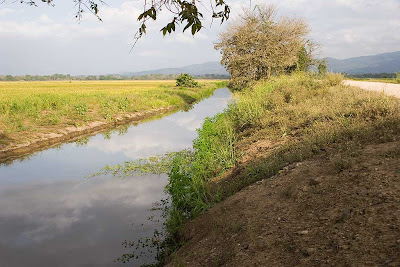
A principios de esta semana visité la provincia de Darién con Euclides Campos, Dave Klauber y Margot Ramos.   En la tarde de 20 de Julio visitamos un propiedad privada con arrozales cerca de Aligandí. Poco despues de llegar encontramos un  Agilucho de Azara  (Long-winged Harrier) de fase oscura, y lo observamos volar y cazar durante unos 10 minutos. Pude tomar algunos fotos de este ave hermosa. Un poco despues vimos otro Aguilucho de Azara —esta vez un individuo de fase clara. Nuestra increíble tarde continuó cuando escuchamos un  Rascón Moteado (Spotted Rail). Tuvimos breves vistas de esta ave difícil de ver en el borde de un arrozal, pero finalmente pudimos obtener vistas más claras —aunque demasiado rápidas para obtener un foto [ eBird ]. A la mañana siguiente volvimos al área y volvimos a ver el Aguilucho de Azara de fase oscura. Otras aves raras que vimos en el área incluyeron a varios Tordos Capuchiamarillos (Yellow-hooded Blackbird) y un Halcón Aplomado ...
Another Long-winged Harrier in Tocumen, a report by Ken Allaire

Alfred Raab, Marc and Joanie Hubsinger and I found a Long-winged Harrier on Sunday at about 1:00, completely by coincidence as we had not read Kilo's post. Alfred and Marc both obtained excellent photo documentation, which will be posted at their earliest opportunity. But our bird was definitely a light-morph male, not a dark-morph as Kilo described— our photos prove this conclusively. We also got close to a couple of rice fields and I had an all-too-brief look at a Spotted Rail in a small patch of irrigated rice.

Paint-billed Crake, Spotted Rail at Tocumen, a report by Björn Anderson

Yesterday morning I visited Tocumen ricefields. Saw thousands of Dickcissels in huge flocks plus 1 Spotted Rail (+1 heard), and 2 Paint-billed Crakes . At least that is what I guess they were due to bright red shields. Unfortunately I did not see the underside of the tail. The crown was definitely gray, not brownish.

Tocumen Rail Update

Imagen
Dave Klauber sent in an update on the Tocumen Marsh rail invasion. Photo by Bill Adsett. This morning [March 28] there were 5 of us who arrived separately, Bill Adsett and Mark (family used to own Tocumen) and Bill and Claudia Ahrens and me, arriving around 6:45. A Field Guides group led by John Rowlett arrived shortly after, but from talking with them they didn't see much different from what we saw. Rowlett commented on I think 6 Spotted Rails, 4 adults and 2 sub-adults. We probably had at least 4, including one or two adults and sub-adults, but no downy young, other than black downy Purple Gallinule chicks. We all had great, long views of a Yellow-breasted Crake (lifer!) and Mark may have seen one or two more. NOT seen or heard were Paint-billed or Gray-breasted Crakes. Several Soras were also seen. In the first hour or so there were only one or two, but a bit later a few came out, including at least two that were doing a strange wing shaking behavior in plain sight on the ber...

Tocumen Rail Update

Imagen
Here's another batch of Tocumen Neocrex photos taken by Jeremiah Trimble on March 9. Especially intriguing is this last photo, that seems to show a bird with both a buffy undertail and black-and-white barring on the flanks (or sides of the tail). Upon examining it, George Angehr remarked Curiouser and curiouser. The specmen I have, while very extensively barred below, has a very few buffy feathers just below the tail. The top of the crown is definitely slaty, with the brown feathers starting just at the rear end of the top of the head. Paint-billed is supposed to have the center of crown brownish, according to the Rails book. As Dodge has already pointed out, the first photos Rosabel got last week seem to show a Colombian. While th full underparts aren't visible, the area just below the tail, the thighs, and lower flanks appear to be buffy without any clear barring, although there are a few pale flecks. The crown appears to be entirely slaty. From the illustration in the Rails...

Tocumen Rail Update

Imagen
Karl Kaufmann reports. Here are some more photos taken March 15 at Tocumen. We had about 10 people this time. We spoke with the person who is leasing the property to grow rice. He said that the field on the west side of the road which had just been harvested was the dry variety of rice while that on the east side was wet rice. He plans to harvest the wet rice in April, so we have a few weeks more to see the rails. His lease runs out in 4 years, so apparently the fields will remain as rice fields at least until then. He also said that this year was the first year that he, or apparently anyone, had planted rice in October instead of December. Apparently the rice responds well to the extra sunlight available in the first part of the year. Perhaps this is related to the reason for such an unusual concentration of crakes and rails. In two more months, the young rails might be able to fly and the parents would disperse when the rice is harvested. Or maybe not. A pair of soras, showing size d...

Tocumen Rail Update

Imagen
This is what Tocumen Marsh's former rail haven looked like this morning, post harvesting and burning. The berm of plenty is now surrounded by scorched earth. Compare with the picture taken on Sunday. Luckily, the other side of the road is still lush and raily. Spotted Rails were still pretty common. Today we saw many more adults than on Sunday, but there were plenty of juveniles and chicks of all sizes present. Soras remained dirt common and we saw a few White-throated Crakes. No Gray-breasteds, though. Also we had great views of two Paint-billed Crakes sunning on the berm at the edge of the rice. These were more like the typical fieldguide illustration of an adult Paint-billed: bright salmon legs, bicolored bill, prominent black-and-white barring on the flanks and undertail. We even got to see the red eye and brown nape and crown. Also seen a couple of times (even photographed by Rosabel) was Yellow-breasted Crake, a lifer for most of the audience (which included Rosabel Miró, ...

Tocumen Rail Update

Word has it that Venicio Wilson visited the rail spot on Tocumen Marsh yesterday and saw Spotted Rail and Paint-billed Crake but, more importantly, farm equipment being deployed for the imminent harvesting of the rice. Then this afternoon Jan Axel Cubilla spent the afternoon on the site and reported the whole right side of the road, where the raily berm was, had been harvested and burned, but the left side was still intact. So, you better hurry. A group of brave birders is again planning to hit Tocumen tomorrow morning, so expect a first-hand report tomorrow.

And More Rail Photos from Tocumen

Imagen
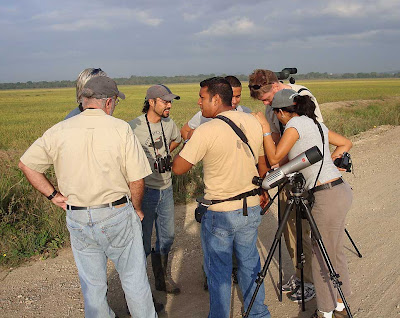
Karl Kaufmann sent in some pictures of the rail site and the rails themselves taken last Saturday and Sunday. The road out to the beach, flanked by channels of iffy-smelling water on both sides. Happy birders looking at the berm. The berm, running perpendicular to the road. The berm, crawling with rails: six soras and a Paint-billed. Juvenile Spotted Rail. Adult Spotted Rail.

Rallid Bonanza in Tocumen Marsh

Imagen
As promised, early this morning found a group of intrepid birders (including Rosabel and Karl Kaufmann, George Angehr, Carlos Bethancourt, Jeremiah Trimble, Steve Langer and Darién and Camilo Montañez) at Tocumen Marsh, hoping for the Spotted Rails and Paint-billed Crakes seen in the area since last Friday. And o what a morning it proved to be, with six species of Rallids seen and lifers galore for everyone involved. A juvenile Spotted Rail was spotted almost immediately upon reaching the spot, which is on the road out to the beach, about 100 meters before the end of the section of road with rice fields and ditches on both sides. More interesting was the gray wing and red leg dangling out of the bill of a Great Egret, which flew off a bit but then was convinced by George to give up its booty: the third Panama specimen of Paint-billed Crake. After a few White-throated Crakes (seen by Camilo), lots of Soras and a smaller number of Spotted Rails, Rosabel called the group from a spot fu...

Details on the Spotted Rail and Paint-billed Crake

Imagen
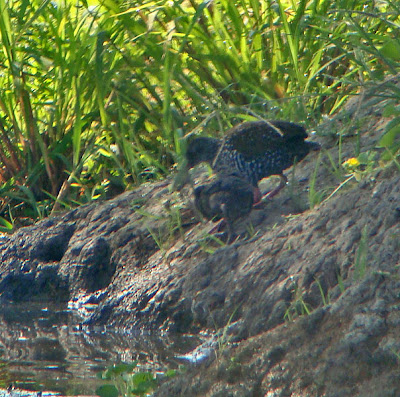
Rosabel Miró sent in a full report of today's goings at Tocumen Marsh, lavishly illustrated with some amazing photos: A las 7:21 am del sábado 6 de marzo, a los 5 minutos de haber estacionado el auto, observé en las Ciénagas de Tocumen un rálido que a la distancia parecía un Gray-necked Wood-Rail. Al verlo con binoculares me di cuenta que era un Spotted Rail adulto (patas rojas, pico amarillo con rojo, pecho blanco y negro) y alerté al resto del grupo. En esta primera observación estaban Claudia y Bill Ahrens y Karl Kaufmann. Minutos después se nos unió Samuel Britton de Ancon Expeditions y dos turistas que lo acompañaban (Marie Joan Hardie y Jean Okuye). En el transcurso de las 2 horas que estuvimos observando en el mismo lugar, un montículo de tierra al lado de un canal de agua, pudimos observar cómo un grupo de 8-10 Jacanas compartían la misma área con 6 Spotted Rails (3 adultos, 3 juveniles), 15 Soras (habían más volando en los campos de arroz), un juvenil de Purple Gallin...

Paint-billed Crake, Spotted Rails in Tocumen Marsh

Rosabel Miró visited Tocumen Marsh this morning looking for Spotted Rail. Seen were a couple of Soras, four Spotted Rails and a Paint-billed Crake, also unreported from panama since 1984. Again, more details to come as they become available.

Spotted Rail at Tocumen Marsh

Imagen
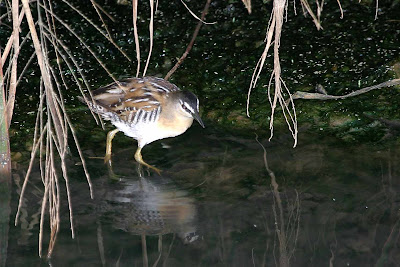
Carlos Bethancourt sent in apparently the first Panama record of Spotted Rail from Panama since 1984. The birds, an adult and chick, were seen this morning in Tocumen Marsh by Field Guides Inc.'s Chris Benesh and George Armistead and Canopy Tower's José Perez, who took the amazing photo above. They were at the edge of a rice field along the road to the beach. A flock of birders is assembling to hit the spot early tomorrow morning, so expect an update within 24 hours.