Entradas

Mostrando las entradas con la etiqueta punta chame

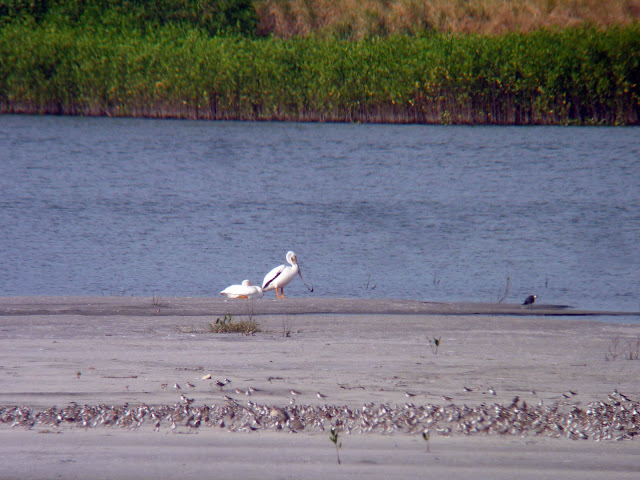
American White Pelicans in Punta Chame

Imagen
The Audubon Panama fieldtrip to Punta Chame of last Sunday, March 20, succeeded in finding the two American White Pelicans that have taken residence in the area. This photo, digiscoped through Venicio Wilson's scope, was sent in by Linda and Tony Ward.

American White Pelicans in Punta Chame, a report by John Brett

I'm currently on a birding trip (well, almost - we brought our wives) in Panama, and today we found two American White Pelicans in one of the ponds on Punta Chame.  We forgot to get waypoints, but it should be pretty obvious where it is. The ponds were the big ones (with white sand around, and a drivable dyke up the middle) on the south side, about halfway down the point.  There were two, and they were not associating with the Brown Pelicans.

White Pelicans still at Punta Chame

Imagen
Delicia, Pedro and Darién Montañez visited Punta Chame at dusk to try for the American White Pelicans that have been there since last Wednesday. The birds were there, unmistakable and right next to the road—my kind of birding. The spot is a large pool between the beach and the road, on the right side 16.7 km from the turnoff at the Interamericana. The banks were full of sandpipers with a few oystercatchers thrown in for variety. Go get'em!

American White Pelican, American Wigeon in Punta Chame

Imagen
Euclides Campos and Laura Reyes went to Punta Chame today, and they found two American White Pelican and an American Wigeon. After you pass the town of Libano and the former shrimp farms (they have cleaned them out) you find the first guard rail to your right side and mangrove to your left. Further, there is an embankment and you can see it from the guard rail.

Forster's Tern at Punta Chame

Imagen
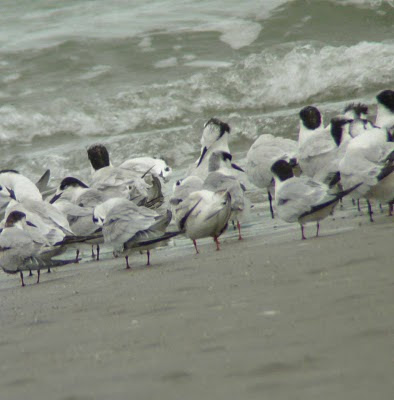
Euclides Campos photographed a Forster's Tern in Punta Chame. Can you pick it out? The flock also had a number of Common Terns , of which but a few winter in Panama.

Cave Swallow at Punta Chame

Imagen
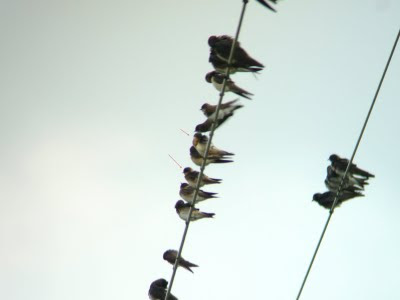
On Friday, October 16, Euclides Campos noticed an odd, light-throated swallow in a flock of Cliff Swallows perched on a wire at Punta Chame. The bird in question is the fifth from the bottom. Adult Cliff Swallows are dark-throated birds (as in the third bird from the bottom), and even the pale-throated juveniles shouldn't be this buffy. Euclides identified this bird as a Cave Swallow, a rare vagrant to Panama with an old record from Tocumen and a recent one from nearby Playa Corona . Upon close scrutiny of the photographs, we see a buffy throat on the seventh bird, too. UPDATE: That seventh bird is but a Barn Swallow, fide Euclides. Our apologies.
More on the Punta Chame White-rumped Sandpiper

Imagen
Euclides Campos sent in two additional photos of the White-rumped Sandpiper he saw at the former shrimp ponds on Punta Chame last Thursday, September 3. Besides showing the typical elongated silhouette (with primaries that extend well beyond the tail), the bib now looks good for an adult bird. The streaked flanks and pale base to the mandible are there if you squint, and Euclides even saw the white rump when the bird took flight.

Sandpipers at Punta Chame

Imagen
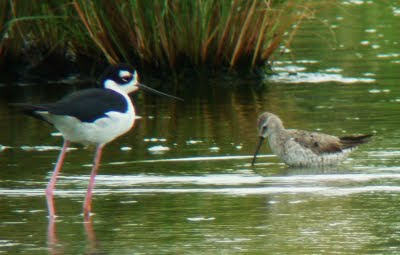
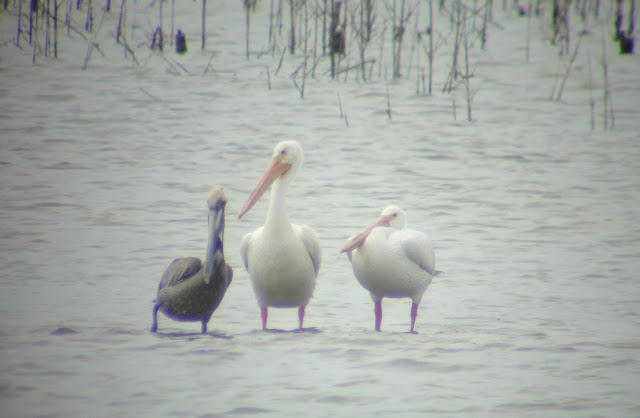
Euclides Campos sends in two interesting photos of interesting sandpipers taken at the former shrimp farms at Punta Chame. The first one shows two stilts: a Black-necked Stilt and a Stilt Sandpiper. Can you tell which is which? Notice especially the typical sloping forehead and pronounced, rounded crown. We say the sandpiper is an adult molting into basic plumage (fide the remains of barring in the underparts and the few leftover black feathers in the mantle and scapulars). Then there's this bird, seen foraging with Semipalmated Sandpipers. It was identified in the field as a White-rumped Sandpiper (and the jizz seems right for that), but the chest seems too dark even for a juvenile. What do you think, freak lighting effect or Pectoral Sandpiper? Click on the photos for full size and chip in (via the comments). [Update: consensus seems to lean strongly in favor of White-rumped Sandpiper]

The Punta Chame Avocet

Imagen
Was seen this morning at 9 am. Drive out towards Punta Chame for 12.8 km and walk the dirt road to the right towards the abandoned shrimp ponds. The avocet was in the flock of stilts on the pond to the right. Seen by Delicia, Pedro, Camilo and Darién Montañez. Then at noon Camilo and Darién showed the place to George Angehr in exchange for a ride back to the city. The bird was still on the same pond, but flew back to the far end of the pond. The pond also had a big raft of Blue-winged Teal, a few Southern Lapwings, and a Glossy Ibis. Photos by Darién Montañez.

More on the American Avocet

Alfred Raab sent in the details about the American Avocet : I discovered the Am Avocet on Thursday [March 6], seen at 9 am on the way out to Punta Chame and again at 4 pm at the same location together with about 100 Stilts. The location is about half way out between Bejuco and Punta Chame. Going out at the left are large flats for rice plantations or something else, all dried up. At this point, accross the road, is a small dirt road, go down the dirt road for less than 100 m. There are ponds on both sides of the road. The Avocet was on the left side with the Stilts. The birds are very shy, approach very slowly. The bird was also seen by my friend Peter Willi of Switzerland. I reported the bird yesterday to Ken Allaire. We'll try for it tomorrow morning, maybe afternoon too. More to come.

American Avocet in Punta Chame

The Canopy Tower's Carlos Bethancourt called in with a third-hand report of an American Avocet seen in a flock of Black-necked Stilts in Punta Chame. No more details are available at this time, but assuming the stilts were on mudflats (and not on the sandy beaches more common around the point), a good place to start looking would be on the mudflats on the mangrovy side, to your left as you drive out. A number of birders happen to be driving by Chame tomorrow morning, so expect an update soon. American Avocet is a rare vagrant to Panama. This is probably the fourth record from the country, with previous sightings from the Aguadulce salinas.

Boobies at Punta Chame

Binocular-less Delicia, Pedro, Camilo & Darién Montañez managed to i.d. the two dozen boobies fishing with the pelicans right at the surf at Punta Chame as Blue-footed Boobies. A couple of Brown Boobies were also present, for variety's sake.