Entradas

Mostrando las entradas con la etiqueta killdeer

Macanas, Aguadulce and Punta Chame, a report by Jan Axel Cubilla
Imagen
 El pasado sábado 28 de enero, Osvaldo Quintero, Euclides Campos y mi persona nos dirigimos hacia Las Macanas. Entre otras cosas, encontramos un Mangrove Cuckoo , al menos seis Killdeers , ocho Caspian Terns , cuatro American Coots , cuatro Fulvous Whistling-Ducks entre los cientos de Guíchichis y una pareja (macho y hembra) de American Wigeons . Sin embargo, más importante, observamos un grupo de al menos 10 Long-billed Dowitchers  identificadas por la llamada, un "kick" enfático, nada musical que fue emitido por las aves mientras descansaban (alarmadas?), y también cuando volaron (en serie). También notamos su pecho de un gris bastante sólido y oscuro y la cola principalmente oscura, muy evidente al volar.  El mismo día, alrededor del mediodía, observamos en las salinas de Aguadulce, una fase blanca de Reddish Egret ... un inmaduro a juzgar por su pico completamente negro. Se encontraba más o menos a mitad de la calle que atraviesa las salinas, cerca de la misma, ...

Birding Chitré, a report by José Carlos García

Imagen
We saw this pair of Killdeers foraging on the grassy areas of the Chitré airstrip; the birds were seen during high tide. A quick stop at Sarigua National Park added Common Ground-Dove , these doves seem to be easier to find here. Among some other birds we saw Pale-eyed Pygmy-Tyrant, Mouse-colored Tyrannulet and two Roseate Spoonbills.

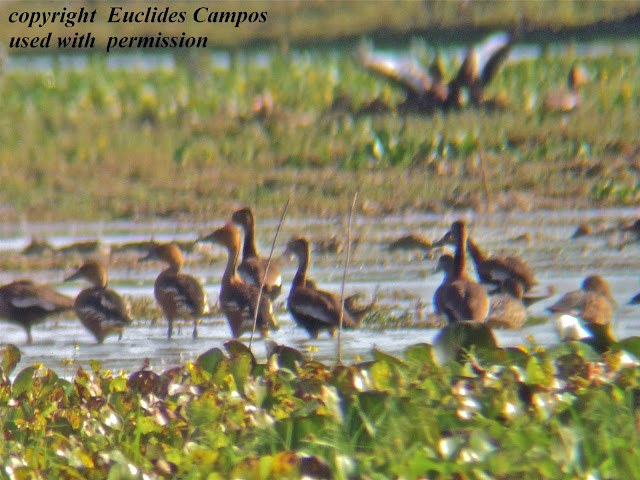
Ducks at Las Macanas

The following report from Dodge Engleman was also received deviously: Karl and Rosabel took Lorna and I to Las Macanas 19th and 20th. We picked up the ANAM girl, Marina Gómez, and went out to the lake. The north end, where the tower is, yielded +/- 100 Black-bellied Whistling-Ducks, with at least 5 Fulvous Whistling-Ducks being seen at one time. Seemed like more, but most seen at once was the 5. The thick-leaved shallow water vegetation was pretty obscurring and most good sights were of flying birds: all fulvous with black wings and white rump patch. a couple seen standing revealed the white scalloping on the sides. Bills and feet dark gray, but with all the immature Black-bellieds around, this wasn't a good field mark. In the south branch there was a strung out raft of 250-300 ducks viewed from less than 100 yds with the light at a 90 degree angle. I say less than 100 yds because I could have flown a wedge into them. All were Lesser Scaup with females out-numbering males about 6-1...