Entradas

Mostrando las entradas con la etiqueta herring gull

Gulls at Costa del Este, yet again

This morning's high tide at Costa del Este produced a 2nd-winter Lesser Black-backed Gul l in addition to the 3rd-winter bird that's been around for a few weeks. Also seen was an all-dark juvenile/1st-winter bird that we're calling a Herring Gull , even though the size seemed to be similar to that of the Lesser Black-backeds. Photos TK. Again, no sign of the Kelp Gulls.

Gulls at Costa del Este

Costa del Este was visited both morning and dusk, yet no sign of the Kelp Gulls was seen. The 3rd-year Lesser Black-backed was seen both times, but the Herring Gulls were in just for the morning.

Belcher's Gull [sic], Kelp Gull at Costa del Este

Imagen
[The bird in question was proven to be but a subadult Kelp Gull . Apologies] Euclides Campos and Ramiro Duque visited Costa del Este today and found not only the Belcher's Gull [sic], but an adult Kelp Gull , plus the third-winter Lesser Black-backed Gull first photographed at the end of february and a Herring Gull . In the photo above, the gull in front shows a white mirror on what we presume is P10 and a white tail, which could show it to be an adult Kelp Gull, while the one in the back may show a black tail and no mirrors on the tips of the primaries, but they're roughly the same size. A Belcher's Gull should be noticeably smaller, so maybe it's another Kelp. More details to come. And now more photos, labeled for your convenience. (Belcher's Gull [sic]) (Kelp Gull) (Lesser Black-backed Gull) As a bonus, he sent this photo of an unfortunate Yellow-breasted Crak e being devoured at Las Macanas Marsh on March 3, where he also found a group of Long-billed Dowitche...

Gulls at Costa del Este (no Belcher's)

Rosabel and Karl Kaufmann and Darién Montañez went to Costa del Este this morning to look for large gulls. No Belcher's was seen, but the 3rd winter Lesser Black-backed Gull was around, plus three Herrings , a Ring-billed and a few Franklin's .

Possible Belcher's Gull [sic] in Costa del Este

Jan Axel Cubilla visited Costa del Este for this afternoon's high high tide and found a strange gull with the thousands of Laughing Gulls just east of the bridge. Originally thought to be a Kelp Gull, when it took flight it showed a lot of black in the tail, which could mean he saw a Belcher's Gull. We'll have to wait for his photos to be sure, but it would be a good idea to visit the area tomorrow for an even higher tide at 4:26 pm. [The bird in question was proven to be but a subadult Kelp Gull . Apologies] We waited for the tide to recede and the gulls to reassemble, but could not find the one we were looking for. We did see two or three Herring Gulls , a few Ring-billeds and a young Lesser Black-backed . The beach at Panamá Viejo had two Elegant Terns and a Long-billed Curlew .

Gulling Costa del Este

Björn Anderson visited Costa del Este on Saturday afternoon. A first year American Herring Gull and 15 Black Skimmers were present. Alas, no Kelp Gull.

Costa del Este Gulls, a report by Björn Anderson

Costa del Este y'day Sunday produced the regular Kelp Gull, but also what I believe was an accompanying first year Kelp Gull. In addition one first year American Herring Gull and one probable first year Lesser Black-backed Gull.

One more try at the gulls in Costa del Este

Imagen
Rosabel and Karl Kaufmann, Jan Axel Cubilla and Darién Montañez spent last afternoon's high tide again braving rain and shine to scour through the flock of gulls at Costa del Este. We got there earlier this time, which gave us time for a first stop at Panamá Viejo, where we had a Lesser Black-backed Gull, a Herring Gull, a few Ring-billed Gulls, a first-cycle Forster's Tern, a diminutive Elegant Tern in front of a huge Royal Tern, a Franklin's Gull and a Laughing Gull with aberrantly-bright-red bill and legs. Photos by Rosabel Miró. Then on to Costa del Este, where we had pretty much the same as on Friday: at least five Ring-billed Gulls, at least three Herring Gulls, at least two Lesser Black-backed Gulls, and the third-cycle type Kelp Gull that has been hanging around for a week or so. Alas, no Kittiwake. Photos by Jan Axel Cubilla.

Gulling at Costa del Este

Imagen
This afternoon, Rosabel and Karl Kaufmann, George Angehr, Jan Axel Cubilla and Darién Montañez hit Costa del Este at high tide looking for the Kittiwake yet again, with no success on that front yet again. This afternoon's 16' tide pushed zillions of gulls to Costa del Este, and all we had to do was find the rare ones in the massive flock of mostly breeding-plumage Laughing Gulls. The third-cycle type Kelp Gull made a late appearance but stayed in sight for a long while, as did not one but three first-cycle Lesser Black-backed Gulls, one of which is shown here next to one of the at least three first and second-cycle Herring Gulls. Also seen were at least five first and second-cycle Ring-billed Gulls (one of which was as ratty as a Herring Gull). Also present were a bunch of cineracens Black Skimmers, a Franklin's Gull, and what proved to be a Laughing Gull with a Heermann's-like black-tipped red bill (the blurry bird inthe middle of all the Laughing Gulls behin...

More Costa del Este Gulls

Imagen
Rafael Luck visited Costa del Este yesterday in search of vagrant gulls, and photographed these three big gulls with pink legs. We're calling these Herring Gulls based on size, leg color and underparts uniformity, but any differing opinions are, as always, more than welcome. The plumage on the one on the left in the first photo looks just as ragged as the one on the one in the second photo, so they may be the same bird. Compare with the happier, healthier one on the right.

The same thing we do every high tide, Pinky: look for the Black-legged Kittiwake.

To no avail. Rosabel Miró, Ariel Aguirre and Darién Montañez didn't get to Costa del Este until two hours after high tide, and by then not even the Kelp Gull was visible. At least two Herring Gulls an four Ring-billed Gulls were around, though, and the flock of South American Black Skimmers was up to 25 individuals.

No Kittiwake for you

Imagen
This morning's installment of Find the Kittiwake at Costa del Este had mixed results. Rosabel and Karl Kaufmann, George Angehr, Venicio Wilson, Jan Axel Cubilla and Darién Montañez were unable to find the needle in the haystack, but had some nice consolation prizes anyway. Top on the list was a presumed Kelp Gull of mysterious age, amply photographed. The legs (whih were dull greenish yellow) were not bright enough for anything else that came to mind, but somehow the back color didn't seem black enough, and the bird had too much dusky on the face and nape. The flock had more Ring-billed and Herring Gulls than any of the participants had ever seen together at once. Also present were about a dozen Black Skimmers of the South American denomination (i.e. with little white on the tail, dark underwings and little red on the bill), a dozen or so Elegant Terns, a Caspian Tern, and a Franklin's Gull. We'll probably hit Costa del Este again tomorrow at noon, so more photos ...

Costa del Este

Imagen
Jan Axel Cubilla visited Costa del Este at high tide on February 8 with Osvaldo Quintero, who photographed the group of Black Skimmers that has been haunting the area. On the 12th, Jan Axel returned and found at least four Herring Gulls, a Ring-billed Gull and a Franklin's Gull as well as the skimmers among the hundreds of gulls, and some Red Knots among the hundreds of shorebirds present. Then on February 17 Itzel Fong visited Costa del Este, where she photographed the skimmers and a handful of Marbled Godwits.

Seabirds Galore, a report by Venicio Wilson

Imagen
Here are some of the pelagic birds we saw during a National Geographic/Lindblad Expeditions trip on board of the Sea Voyager from Costa Rica to Panama. Dec 31: During while sailing from Coiba Island to the Panama Canal, some 60 nautical miles west of Punta Mariato I spotted a "rare" tern. After closer observation we realize it was a juvenile Red-billed Tropicbird. It was together with some Laughing Gulls and Black Terns. [A rare bird anywhere away from Bocas del Toro—Ed.] Later during that same afternoon, while looking for whales, dolphins and marine life, we got 2, maybe 3, Pomarine Jeagers. Several pictures where made of these birds. They floated and flied around the boat for over and hour. Jan 2: During the ducking operation at Pier 6 in Cristobal Port we got an adult Parasitic jeager chasing a laughing gull. Also they were several Ring-billed Gulls and a Herring Gull. I am not very sure of this last 2 birds so I hope the pictures and your expertise help.

More Gulls at Costa del Este

Imagen
Rosabel Miró, Bill Porteous, Jan Axel Cubilla and Darién Montañez went to Costa del Este at high tide to try and find the Kelp Gulls but instead found an adult Lesser Black-backed Gull. This bird was not as big as the Kelps, and was much lighter on the back, but what really made it stand out was the dark streaking on the face and head, which made its yellow iris look even brighter. Its legs were bright yellow, and its yellow bill had a red gonys-spot (but the gonydeal angle was not as pronounced as on the Kelps). Also at the mud was a Herring Gull and two Ring-billeds (a juvenile and an adult), and a bunch of Franklin's Gulls mixed in with the Laughings.

Sabine's and Kelp Gulls at Costa del Este

Imagen
Bill Adsett, Loyda Sánchez, Delicia and Darién Montañez, Rosabel and Karl Kaufmann and Guido Berguido went to Costa del Este at dusk to look for the Kelp Gulls armed with all sorts of photographic equipment. After walking along the coast all the way to the river and checking on hundreds of Laughing Gulls, we discovered a group of gulls standing on the other side, the original Kelp Gull spot, so we rushed in that direction racing against the imminent darkness. Turns out everything was right there: (just) one Kelp Gull (first spotted by Loyda), at least two each of Herring and Ring-billed Gull and, the bird of the day, a juvenile Sabine's Gull. This bird, spotted by Rosabel, had a brownish back, nape and sides of the neck, and a white forehead, chest and underparts. It had a smudge of white behind the eye, and when it flew up Karl was able to see the black terminal band on its white tail. After that the bird was seen again, this time with its head tucked on its back, and in extremely...
Shorebirds at Panama Viejo

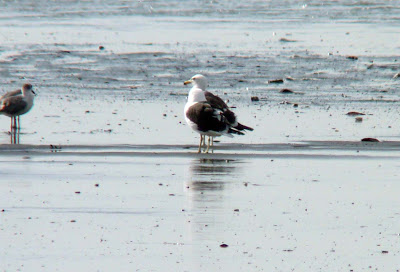
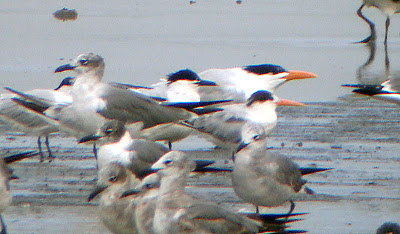
Rosabel and Karl Kaufmann spent the afternoon shorebirding at Panamá Viejo. The mudflats between the IPAT building and the old stables had a big flock of shorebirds, and a few gulls and terns. The highlight was a Dunlin, picked out from the nearby Western Sandpipers by its larger size and differently shaped bill. The same mudflat also had a Long-billed Curlew, possibly the same bird seen there on the Christmas Bird Count. There were plenty of Whimbrels nearby for direct comparison, so picking it out was especially easy. There were large numbers of sandpipers, plovers and dowitchers, and a large flock of Surfbirds had a Red Knot molting into breeding plumage. The gulls were mostly Laughing Gulls, but there was one Ring-billed and one Herring Gull.

Ducks at Rodman Ponds, etc.

Five American Wigeon were found in the morning at Rodman Ponds. The Cattle Tyrant was seen on its usual haunts behind the ARI building at Amador. The Herring Gull was there, too. This morning (dec 25) Karla Aparicio, Ruby Zambrano and Darién and Camilo Montañez went to Rodman Ponds to look for the Pintail, but instead found at least five American Wigeon, including a male in breeding plumage. They were first seen in fligh, their size and wing pattern distinguished them from the Blue-winged Teal they were flying with. Once they "landed" the head pattern of the male was seen clearly, the white forehead being very conspicuous. The cinnamon flanks and the contrasting white belly and undertail coverts could also be seen clearly. Later, the group visited the ARI building at Amador where Ruby found a Cattle Tyrant and, minutes later, the Herring Gull. There was only one Blue-footed Boobie in the concrete blocks at Punta Culebra. What better Christmas present than a lifer? Go get...

Herring Gull at Amador

The  Herring Gull was seen again, this time behind the ARI building at Amador.

Herring Gull in Costa del Este

A first winter Herring Gull was seen at dusk (high tide) at a newly discovered roost at Costa del Este by Rafael Cortez, Jan Cubilla and three fourths of the Montañez family. The gull was noticeably larger than the Laughing (and Franklin's) Gulls it was flying with. Its breast was mottled brown and it had pink legs and a pale bill base. The back was brownish-black as were the wings, with a darker trailing edge in the secondaries. The rump was white with some dark splotches that formed a dark tail band. The Herring Gull was in a small flock of gulls, most (at least 85 of them) were Franklin's in both adult and first winter plumage. Also seen were large numbers of Black Terns and a pair of Glossy Ibis. The new roost is in a flooded grassy field located to the left of the Corredor Sur, just beyond Snipe Field.